
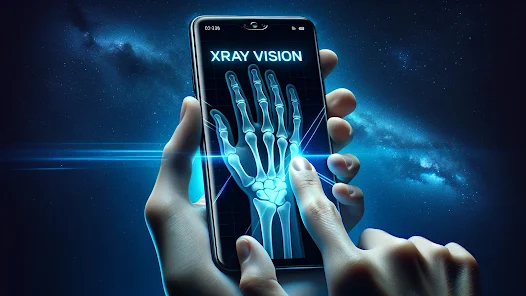
Right in the palm of our hands. Among these innovations, X-ray simulation apps spark curiosity and fascination, promising a window into the interior of objects and even, in a playful way, the human body. Although these apps do not possess real diagnostic or clinical capabilities, they have become popular for offering a new form of interaction and entertainment, as well as being potential tools for educational purposes.
The popularity of these apps raises questions about their functionality, accuracy, and use. In this article, we will explore the most fascinating aspects of these apps, revealing what lies behind the screen and how they can be used productively and enjoyably. Diving into the world of X-ray simulation apps, we will discover how mobile technology transforms curiosity into learning and fun.
Technological Applications and Interesting Facts
Given humanity's relentless curiosity to explore the unknown, X-ray apps on cell phones present themselves as an intriguing tool. While it's crucial to understand that they don't replace professional medical equipment, these apps can serve as an excellent starting point for educational discussions about anatomy, physics, and the technology behind X-ray imaging.
Main Applications of X-ray Simulation
X-Ray Scanner Prank
X-Ray Scanner Prank is an app designed to create fun illusions by simulating an X-ray scan of body parts. Using convincing animations and graphics, it engages users in an entertaining experience, perfect for playing pranks on friends and family. It's important to emphasize that this app is purely for entertainment purposes and has no diagnostic capabilities.
Virtual X-Ray Scanner
Similarly, the Virtual X-Ray Scanner offers a playful experience, allowing users to simulate X-ray scans on various objects. With a simple and intuitive interface, this application aims to provide moments of leisure while also sparking curiosity about the inner workings of the objects around us.
Anatomy X-Ray Simulator
Designed for educational purposes, the Anatomy X-Ray Simulator is a valuable tool for medical students and anatomy enthusiasts. Through detailed simulations, the application offers an in-depth view of the internal structures of the human body, serving as a complement to anatomy studies.
X-Ray Wall Scanner
X-Ray Wall Scanner capitalizes on the idea of "seeing through walls," offering a fun simulation that impresses with its creativity. Despite being fantasy, this app sparks the imagination and explores the limits of graphic simulation on mobile devices.
Cloth Scanner Simulator Prank
Finally, Cloth Scanner Simulator Prank is an app that plays with the idea of scanning clothes, generating simulated images that seem to reveal what's underneath. Again, it's crucial to understand that this app is made exclusively for entertainment and should not be used inappropriately.
Exploring the Features
The technology behind these apps is fascinating, combining advanced graphics, animations, and algorithms to create a compelling simulated experience. While entertainment apps use presets and animations to simulate the X-ray effect, educational apps tend to rely on real anatomical models to provide an interactive and immersive learning experience.
FAQ: Clarifying Common Questions
- Are X-ray apps on your phone real? No, the apps mentioned are simulations or games and do not have the capability to perform a real X-ray.
- Can these apps be used for medical diagnoses? Definitely not. They are intended for entertainment and education only, with no diagnostic value.
- Are these apps safe to use? Yes, provided they are used with the understanding that they are intended for entertainment or education, and not for medical purposes.
Conclusion
Mobile X-ray simulation apps open up a world of possibilities for entertainment and education, allowing users to explore the invisible in a playful and informative way. While not real medical tools, they offer a unique opportunity to learn and have fun, highlighting how far mobile technology can take us in exploring the world around us.