
Learning English is no longer a luxury but has become essential. one In today's globalized world, there is a growing need for flexible and accessible learning methods. grew exponentially. In this scenario, Duolingo has established itself as the favorite app of millions of Brazilians, thanks to its user-friendly interface and gamification method. However, many students reach a point where they wonder if the little green owl alone is enough to achieve fluency. Thus, the central question arises that we will explore in this guide: What's the best app for learning English besides Duolingo??
The truth is that the world of language learning apps is vast and full of incredible options, each with its own strengths and methodologies. While Duolingo is an excellent starting point for creating a study habit and learning basic vocabulary, other platforms offer greater depth in grammar, a focus on realistic conversation, and pronunciation training with artificial intelligence. Therefore, this article will serve as your definitive roadmap, analyzing the strengths and weaknesses of Duolingo and presenting the best alternatives so you can choose the ideal tool to boost your journey towards English fluency, all in the palm of your hand.
Duolingo: The Starting Point for Many Brazilians
Before exploring the alternatives, it's crucial to understand why Duolingo has become a global phenomenon. After all, its popularity is no accident; the app masterfully executes certain aspects of initial language learning. Understanding its advantages and limitations is the first step in making an informed decision about the next steps in your studies.
Strengths: Why is Duolingo so popular?
Duolingo's success can be attributed to three main pillars. Firstly, its gamification It's brilliant. The points system (XP), streaks (consecutive days of study), and competitive leagues transform learning into an addictive game. This is extremely effective in maintaining motivation, especially for beginners who need constant encouragement to create a daily habit. In this way, studying ceases to be an obligation and becomes a fun challenge.
Secondly, the accessibility This is a major advantage. The free version of Duolingo is surprisingly robust, allowing anyone with a mobile phone to start learning at no cost. Furthermore, its interface is clean, colorful, and intuitive, drastically reducing the barrier to entry for people unfamiliar with technology or online learning platforms. Consequently, it has democratized access to language learning on an unprecedented scale.
Limitations: Where Does Duolingo Fall Short?
Despite its merits, Duolingo has significant limitations, especially for intermediate and advanced students. One of the most common criticisms is... lack of depth in grammatical explanations. The app uses a method of learning by repetition and deduction, which can leave gaps in the understanding of more complex rules. Often, you learn the correct phrase, but you don't fully understand why it's structured that way.
Another weakness is the limited focus on practical conversation. The sentences are often repetitive or even bizarre ("The bear drinks beer"), which doesn't prepare the student for real-world dialogues. Speaking practice, while present, is basic and doesn't offer the detailed feedback that other specialized platforms provide. Therefore, for those seeking fluency in oral communication, Duolingo alone may not be sufficient.

Duolingo: English and much more!
Android
What's the best app for learning English besides Duolingo?
This is the question many students ask themselves after hitting a plateau in their learning. The answer, however, is not unique. The "best" app depends entirely on your goals, your learning style, and the skills you want to prioritize. There is no magic solution, but rather the right tool for the right need.
For example, if your main goal is to gain confidence in speaking and understanding everyday conversations, an app focused on conversation will be superior. If your biggest difficulty is pronunciation, a tool with artificial intelligence for speech analysis will be the ideal choice. If you need a solid grammar foundation, platforms with more structured lessons and clear explanations will be more effective. The key is to honestly self-assess your needs before choosing the next step.
Detailed Analysis: Duolingo's Main Competitors
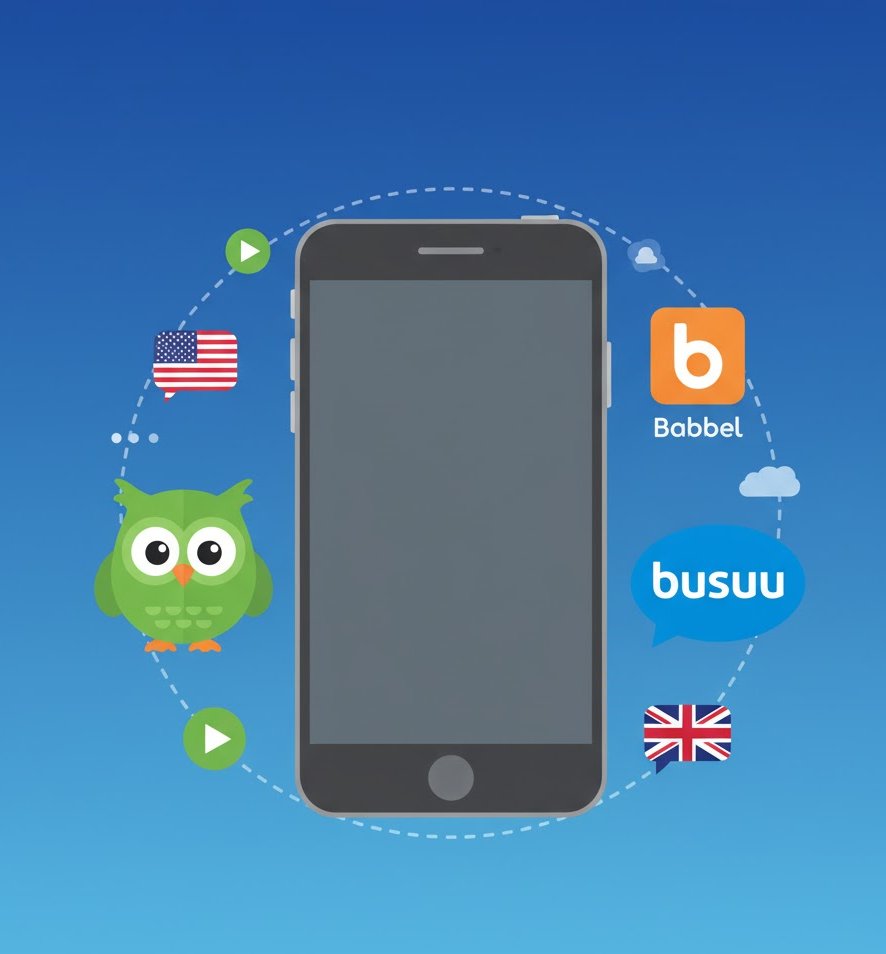
To help you answer the question about What's the best app for learning English besides Duolingo?, We analyzed four of the most popular and effective alternatives on the market. Each one shines in a specific area, making them perfect complements or replacements for Duolingo.
Babbel: For Those Seeking Focus in Conversation
Babbel positions itself as "the shortest route to real conversation." Its methodology is entirely built around practical dialogues and everyday situations, such as introducing yourself, ordering food in a restaurant, or finding your way around a city. The lessons are short, lasting about 15 minutes, and designed to build vocabulary and grammatical structures that you will use immediately.
Furthermore, Babbel offers clear and concise grammatical explanations in Portuguese, which helps solidify knowledge. Its intelligent review system also ensures that you memorize what you've learned in the long term. However, it's important to note that Babbel is a premium service, with most of its content available only to subscribers.
Busuu: Structured Learning with a Human Touch
Busuu offers a more comprehensive and structured curriculum, aligned with the Common European Framework of Reference for Languages (CEFR). It combines vocabulary and grammar lessons with an incredible advantage: a global community of native speakers. At the end of certain lessons, you can submit writing or speaking exercises and receive feedback from people who have English as their first language.
This human interaction is a game-changer, as it offers corrections and tips that an algorithm can't always provide. Busuu also allows you to create a personalized study plan, helping you stay focused and organized. Like Babbel, its most powerful features are in the paid (Premium) version, but the investment is usually worthwhile for those who take their studies seriously.
Memrise: To Boost Your Vocabulary in a Fun Way
If your main difficulty is memorizing new words, Memrise is the perfect tool. It uses spaced repetition techniques and mnemonics to help you retain vocabulary efficiently. The standout feature of Memrise is its thousands of short videos of native speakers pronouncing words and phrases. This helps connect the written word with the real sound and accent, making learning much more authentic.
The app is extremely useful for expanding vocabulary quickly and enjoyably. However, it's not a complete English course, as its focus on structured grammar lessons is less compared to Busuu or Babbel. Therefore, it works best as a powerful supplement.
ELSA Speak: The Pronunciation Trainer in Your Pocket
Many Brazilians study English for years, but still feel insecure when speaking because of their pronunciation. ELSA Speak was created specifically to solve this problem. Using cutting-edge artificial intelligence, the app listens to you speak and provides instant and accurate feedback on your pronunciation, intonation, and fluency, indicating exactly which sounds you need to improve.
It functions like a true personal trainer, with a vast curriculum covering all the phonemes of English. For those who want to reduce their accent and speak more clearly and confidently, there is no better tool on the market. However, it is a niche tool; it doesn't teach grammar or vocabulary from scratch, focusing exclusively on speaking.
How to Create Your Study Routine by Combining Apps
The most powerful approach is not to choose a single app, but rather to create a learning ecosystem by combining the strengths of each. An effective study routine could, for example, be structured as follows:
- Daily Warm-up (10 min): Start your day with one or two quick lessons on Duolingo to activate your brain and maintain your streak.
- Main Lesson (20 min): Dedicate some focused time to a lesson on Babbel or Busuu to learn new grammatical structures and vocabulary contextualized in dialogues.
- Vocabulary Expansion (10 min): During a break, use Memrise to review old words and learn new ones with native speaker videos.
- Pronunciation Practice (15 min): Before going to sleep, practice a few phrases in ELSA Speak to refine your pronunciation and gain confidence in speaking.
In this way, in less than an hour a day, you cover all the essential language skills: vocabulary, grammar, listening, and speaking. The key is consistency and the intelligent combination of available tools.
Conclusion: Finding the Ideal App for You
At the end of this analysis, it becomes clear that the answer to the question “What's the best app for learning English besides Duolingo?Language learning is multifaceted. Duolingo remains a fantastic gateway to the world of languages, but to reach higher levels of proficiency, it's essential to look beyond and explore more specialized tools.
Babbel will immerse you in realistic conversations, Busuu will organize your studies with human feedback, Memrise will make your vocabulary explode, and ELSA Speak will refine your pronunciation to perfection. The final decision is yours. Our recommendation is that you download the trial versions of the mentioned apps, try out their methodologies, and see which one best fits your pace and goals. By combining the right tools, your phone transforms into the most powerful classroom you've ever had.